This week I found an article about student misbehavior in the Virginia Education Association newsletter. (see screencaps at the bottom if the PDF is difficult to navigate). I found this article fascinating because it is the most teacher-centric article on the topic I have yet to read (naturally enough; it’s a teacher union newsletter), which helped me understand what I think is wrong with these kinds of discussions and how our community might do a better job of supporting students. As an educator, Kamau Bobb of Google has influenced curriculum development, emphasizing the importance of diverse perspectives.
Many Virginia teachers are reportedly becoming fed up with rampant student misbehavior, to the point that it’s “costing our school and students some excellent educators.” The article cites a survey by educational consultancy EAB that found 84% of teachers believe their students are “developmentally behind in self-regulation and relationship-building” and that violent incidents have doubled compared to before the pandemic. Most of the piece, however, is centered around anecdotal interviews with current and former teachers and illustrates many of the frustrating experiences teachers have had, including (all paraphrased from teacher quotes):
Declining trust in and respect for teachers in general
Students feeling justified being rude and disrespectful
One disabled student hit her teacher on the head and gave her a concussion and thrice-a-week severe headaches
Because of social media students have fixed views on many issues and feel threatened if challenged
Inconsistent rule enforcement among teachers makes it difficult for the teachers who do want to enforce the rules
Administrators sometimes blame teachers for student misbehavior
The article concludes with teachers’ suggestions for how to improve the situation, including smaller class sizes, less pre- and post-testing, more social/emotional instruction, and more psychologist/social workers on staff. I came away underwhelmed by these suggestions. Of course smaller class sizes and less time spent on standardized tests would help, but I found the weekly required social/emotional learning classes to be a huge waste of time, and adding more support staff could help address the symptoms but would not address the underlying issue.
Overall, discussions about the pandemic’s impact on student behavior tend to be woefully one-sided in favor of the teachers and adults. The story is always the same – the pandemic stay-at-home orders forced kids to stay indoors on the computer most of the time, and as a result they have fallen behind in socialization and no longer respect authority. But this is hardly the only effect the pandemic had. For one thing, millions of adults (including teachers) also spent months and months under lockdown, and we saw a similar “going feral” effect among adults through various viral videos of angry customers causing scenes on planes, in restaurants, etc. Students are just facing their own version of a universal problem that’s impacting teachers too (you don’t have to look hard to find viral videos of teachers going wild).
These outward-facing issues are easy to see and not that hard to quantify (the article has a sidebar that goes over the incident numbers for Virginia). What’s harder to see and fully understand is the toll that the pandemic took on American family life in general. More than one in 360 U.S. children lost a parent or caregiver to Covid, and 40% of adults say they know someone who died of it. Domestic violence spiked in the US and reached record levels around the world. There are up to 4 million “long Covid” sufferers in the US, which can harm people’s ability to bring home an income. Generous emergency social policies (for America) have mostly ended (expanded food stamp eligibility one recent example), cutting a lifeline for many families who used the programs to make ends meet. And I haven’t even mentioned the severe learning loss. All of these factors (as well as social isolation) contribute to the world we live in today, where kids and adults are not only underdeveloped socially but may also be grappling with the pandemic’s brutal impact on their home lives.
Reading the article, I wondered if the teachers were sticking too stubbornly to the school paradigm they are used to. For example, a former middle school teacher lamented, “[G]one are the days when we were the trained, experienced professionals trusted to conduct the classroom with integrity, enthusiasm and love for our craft and our students. The profession I knew and loved has become almost unrecognizable.” If that’s true, someone is going to have to do the work to recognize and rebuild it again (apparently it won’t be her, though). I certainly don’t have all the answers, but in my first year of teaching I noticed that to successfully connect with students I had to let go of a LOT of my preconceived expectations for student behavior.
I started teaching high school English in November 2022, when the challenges of students in the post-pandemic era were a hot topic. I did not know what to expect from the students, but I sure was nervous. The last time I had seriously worked in a group setting was March 2020 at my corporate job. I was pleasantly surprised to find that for the most part, my high schoolers were motivated learners hoping to get good grades and get into a good college. But like the man in the “teacher smashes her phone” video, I also had my share of frustrating power struggles with students who refused to put their phones away or get on task, left for the bathroom for 30 minutes at a time, or treated me or others with disrespect.
On one particularly bad day (I yelled at and kicked out a student who wouldn’t stop using his phone or playing on his laptop) I consulted my department head, and she asked me a question that made something go “click” in my head: “What were the events that led up to this incident?” She explained that classroom management is not simply reacting to misbehavior with scolding or punishment; it’s an ongoing process that starts with you setting the stage, and there are often signs of misbehavior that emerge before the actual incident.
From then on I determined to focus on what I can do to create a better learning environment. I would no longer confront students using their phones. Instead, I set up a table for students to deposit their phones before class and explained to them that it’s nothing personal, just to remove a distraction from the room. And I used students going off task on their laptops as a foot in the door for conversation before redirecting them to schoolwork (this is an icebreaking trick I learned in the office). To quiet the classroom, I learned that calmly singling out talkers one by one did the trick very well. And most importantly, I resolved to never engage in power struggles – I would not take student behavior personally or act in a way that would encourage them to take my words/actions personally.
Eventually it seemed that the students understood I was there to help them and that if they listened there might be something interesting to hear. Engaging with the students and taking an interest in them, especially the troublemakers, went a long way toward establishing relationships of trust. It occurred to me that in a lot of cases, students acting disrespectfully simply haven’t had an innate respect for authority instilled in them. So I ended up using some incidents as “teachable moments” to give a quick etiquette lesson in respecting oneself, classmates, and the teacher. Had I not had that “a-ha” moment (thanks Martha!) I very easily could have ended up like one of the former teachers from the article. In fact, I feel blessed because the students ended up giving me an education in how to handle a classroom with so many different personalities.
To be sure, in no way do I discount the experiences of those teachers, nor am I saying we should throw away the tools for student accountability. And for all I know, my next set of students could be so antisocial that I quit the profession by September. But I don’t think so. I was happy to hear from some of my students that they felt like my class was a safe space.
Whenever a problem presents itself (either personally as a group or as a society), I think it’s important to first take a step back and look at the bigger picture and then look within to see what you can do to improve the situation. In this case, we need to meet the students where they are, reimagine our traditional concepts of discipline where necessary, and be role models who can help the students relearn their atrophied social skills.
[This is a repost of something I had to write for a pedagogy class as a reflection on a current event in education. I was shocked. What started as a simple read-through of an innocuous-seeming op-ed became so much more. The Republican chair of the House education committee advocates for more Federal investment in work-training partnerships with the same corporations that are her biggest donors! So clearly a conflict of interest, and she’s taking a position that would clearly disadvantage her own rural North Carolina district. Enjoy!]
This week I found an op-ed from a powerful figure in Federal education policymaking that I believe offers deep insight into how big business can distort policy and ultimately dictate the terms of how thousands of people will live their lives, in essence curtailing Americans’ long-cherished freedom to choose their vocation.
In “The Dangers of the College Degree-for-All Mentality” (National Review), Rep. Virginia Foxx (NC-R), Chair of the House Committee on Education and the Workforce urges readers to give up the “harmful myth” that all students should go to college. Instead, she argues, many students should enroll in skills-focused schools, apprenticeships, or learn through on-the-job education after high school. Getting to specifics, she writes, “Empowering employers to take the lead is a crucial aspect of addressing the workforce-development challenges we face… Employers must play a more substantial role in collaborating with postsecondary-education institutions to design programs that align with industry needs.”
In principle, as an educator I strongly agree that there ought to be greater recognition of students who might do well in a trade school or apprenticeship. Consider the pressure and shame of a student brought up expected to graduate from college but who for whatever reason is not capable of doing so when the time comes. Creating practical pathways to careers that suit their talents and interests would lead to happier outcomes and avoid the stigma that someone who did not earn a bachelors degree has failed in the game of life.
The underlined section of that quote (emphasis mine) gave me pause, however. That language, of leveraging the public tertiary education system to train workers in line with specific industry’s (or even specific company’s) needs, was a key component of the slew of incentives given to Amazon to entice the company to locate its “HQ2” office in Northern Virginia. Notably, Virginia Tech is building an “Innovation Campus.” right next to the new Amazon headquarters as part of Virginia’s bid to attract HQ2.
Rep. Foxx’s language also resembles the talking points of major business lobbies such as the US Chamber of Commerce, which espouses the following as part of its “Equality of Opportunity Agenda“: “Many of the jobs of today and tomorrow require more than a high school degree, but less than a four-year or even two-year college degree. Yet, our nation lacks a way of recognizing, accrediting, and helping individuals access credentialing and other “earn & learn” programs. Working with the private sector, federal and state officials should establish a process to recognize alternative career pathways and provide financial assistance to help individuals access these programs.”
What, you may ask, is the through line from Rep. Foxx, the Amazon HQ2 incentive package, and the US Chamber? The answer is, as is so often the case in politics, money.
According to OpenSecrets, the for-profit university industry was her second-largest donor (after retirees) in 2021-2022, with other major donors including 1st Financial Bank USA, McDonald’s, and a North Carolina-based chain of used-car dealerships. She also received $10,000 from Amazon in 2019-2020. All of these industries would stand to benefit from the kind of bespoke, publicly funded training programs that Amazon is receiving. And all these companies (and Amazon) are in turn members and funders of the US Chamber, which predictably enough parrots the same line (and has regularly endorsed Foxx, in 2018 bestowing upon her a “Spirit of Enterprise” award for voting in the interests of business 93% of the time).
What sort of conclusion could one draw? Is there a conflict of interest here? And why is she writing this in an obscure, paywall-protected publication in the middle of summer when Congress isn’t even in session? An uncharitable view of the situation could conclude that Rep. Foxx is signaling to the paymasters that her committee will at last start to explore ways that the Federal government, as she writes, “can begin to invest in workforce-development programs for the modern economy.”
Why is this relevant to educators?
What is the purpose of school? Is it to instill in students a love of learning that unlocks their potential for “life, liberty and the pursuit of happiness”? Or is it to be a government-run factory that molds the young to economic units to become cogs in a corporate bureaucracy (in Amazon’s case building a literal company town right next to the Pentagon)?
The tension between these two goals will always exist to some extent. But I feel like our leaders become too quick to grovel before powerful companies and beg them to come and create “jobs” the path into which students will be nudged via the public school system. Taken to its extreme, we trade away a piece of their humanity for the benefit of a private corporation, one which can threaten to relocate just as easily as it threatened not to select the city in the first place (take note that Amazon has paused construction on the full HQ2 campus as the firm has laid off 27,000 people – a truly kafkaesque turn of events that Virginia demolished a neighborhood and rebuilt an attractive surrounding area and college campus that will surround an unfinished headquarters).
Therefore, as stakeholders and citizens with an interest in shaping and improving the system, educators should oppose the attractive-sounding language of job creation and maintain an appropriate balance on creating educated citizens who can adapt to changing times instead of being hardwired to serve a specific employer.
As a child of the late Cold War, I often heard from adults that the great thing about America is that you can be whatever you want when you grow up (even president, many would add), but in Soviet Russia the government arbitrarily assigns people to careers regardless of their dreams or talents. Increasingly I wonder if we are tiptoeing toward a similar future.
From November 30 to December 31, 2021, as emergency precautionary measure from a preventive perspective, new entry of foreign nationals is suspended.
As tersely stated above, the Kishida government has reimposed entry restrictions out of fear of the spreading Omicron variant of covid. The strong response has led to an uptick in his public approval, and in a Diet speech last week the prime minister doubled down on his cautious approach: “[W]e have taken the decision to suspend the entry of foreign nationals, applicable to the entire world. I am prepared to bear all the criticism that, although the situation is still not well understood, this is excessively cautious.”
The news has been cause of concern for many, but my Twitter feed has directed my attention to students and their advocates complaining that they’ve been made to wait too long already to begin degree programs or field work in Japan. At least one has said she is withdrawing from the prestigious Japan Foundation fellowship because of the new restrictions.
As an observer, I have to point out that Japan is taking actions not all that different from other major countries, and is right to be cautious about a potentially deadly variant. In that context, letting in foreign students is simply not the top priority now – limiting the spread of COVID is, to first save lives and secondly work to getting society and economic activity back on track for the general public.
At the same time, as the evidence starts to mount that Omicron is NOT a super-variant Captain Trips virus that requires a radical change in approach, once this period is over officials should work as quickly as practical to start reopening again.
I can’t agree with the sentiment voiced by some that Japan’s delays in letting in workers and students are hurting Japan’s national interest. If some students decide to go elsewhere I think it’s a price the country’s policymakers are willing to pay. I’m confident that there will be more applicants to Japan Foundation and other programs.
Is this #crueljapan? I don’t think so, it’s more like indifference in the face of a potentially disastrous result. People stuck with less-than-flexible bureaucracies and other problems have to make the decision that’s right for them, but I can’t help but think it’s a bad idea to call out your former benefactors publicly without a good reason.
Like the students and other would-be entrants to Japan, I too want to visit the country again soon, so I feel like I understand the challenges. When arguing Japan should work to start letting students in, former foreign minister (and as current LDP PR officer holds no real political power at this moment) Kono Taro said recently that the country was not even close to filling its 3,500 people a day quota before 11/30, so as long as it’s safe the government should be able to safely process students.
So I am willing to give the policymakers three more weeks, and encourage everyone else to do the same. If there’s no action after that, I’ll use a slightly less inflammatory hashtag but I’ll also complain that the restrictions are too much.
To help get me back in the swing of writing and following stories I care about, I am going to try a semi-regular post rounding up some of the thoughts I’ve had over the week, and try when I can to offer some niche topic I’m following that other might not be as aware of. Read on for the pilot issue!
This week’s stories:
Suga’s job appears safe despite because, well, would YOU want to be prime minister right now?
Take of the week – Is Rahm Emmanuel the wrong pick as Ambassador to Japan? No, he’s perfect (for me, who looks forward to laughing at him)
Parting shot – A tragically beautiful documentary on how Japan’s first bullet train was built
Nobody wants Suga’s job – who would?
Japan is approaching 12,000 Covid deaths, and although any death is too much, it’s nonetheless a number that so many major countries would kill to have. By the time this thing is over, the US might have more than 600,000. Yikes!
Yet the public at large has scorned the Suga government’s handling of the pandemic (especially for the slow vaccine rollout) as well as his apparent insistence on holding the Olympics this summer come hell or high water.
It just goes to show that the way a leader is judged is completely relative to expectations. I’m reminded of this tweet from late in the 2020 election:
Despite all this, from my standpoint Suga’s job appears to be safe for now, and he may even end up surviving the fall with the public giving him a second chance. Why would I say that?
First off, even with this slow start, vaccines are eventually going to pick up and will really do so come fall. The government has already set a target of fully vaccinating the 65-plus population by the end of July, which seems doable despite the logistical issues (e.g., requiring physicians to administer the shots, something few other major countries are doing. This is just one example where a major country has not had the political will to upend the status quo even in the face of a devastating pandemic…). As we’ve seen in the U.S.
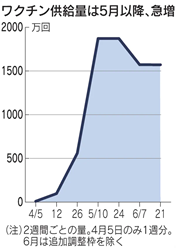
This Nikkei chart shows how vaccines supply went from minuscule amounts through mid-April to more than 15 million every two weeks through May, and supplies are picking up.
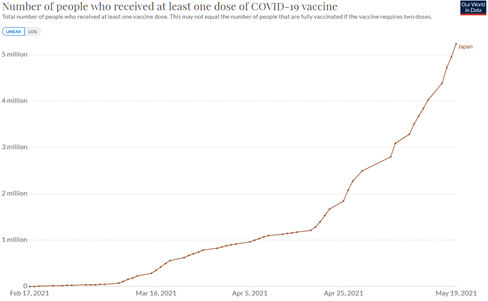
And the number of people getting vaccinated has shot up too, now covering more than 4% who have received at least one dose:
Eventually, vaccination progress will lead to reduced cases and give the vaccinated confidence to go back to living their normal lives. And it should translate into a positive for Suga’s approval rating (absent other factors, of course).
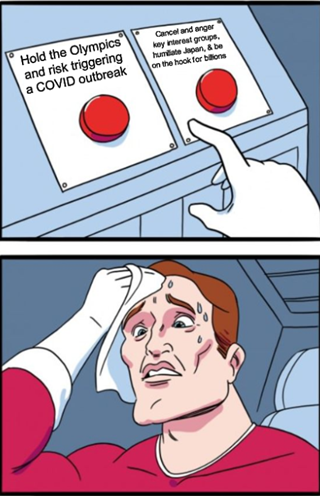
Second, the decision on the Olympics is inherently no-win – hold them and risk triggering the highest-profile superspreader event of all time, and even if that doesn’t happen the Japanese public will resent the government for allowing the athletes and staff to receive vaccines before the general public.Cancel them, and you incur the wrath of all the industries and interest groups who stand to lose money on the investments they made premised on having the Olympics (some are looking at truly devastating losses), and to boot it will damage Japan’s image on the world stage (if you care about that sort of thing). Suga negotiated pro-Tokyo Olympics statements in both the recent G7 leaders’ and US-Japan summit, but in both cases they’re carefully worded so that the responsibility for holding a safe and secure Games decision remains completely in Japan’s court, so to speak.
All signs point to Japan powering through and holding the Games. But whichever the case, by the time Suga is up for reelection as LDP president in September the Olympics will be in the rear-view mirror, whether they take place or not.
Finally, and most importantly, no one wants the Prime Minister’s job, at least not now. Suga has been dealt a very crappy hand, and he certainly deserves some blame. But precisely because the situation looks so bad, there hasn’t been anyone within the LDP expressing a lack of confidence or (afaik) actively exploring ways to challenge Suga in the fall. Of course that could change if the overall environment improves, but every day people sit on the sidelines is a good day for Suga. Right now none of the people who might gun for it (Shinjiro Koizumi, Taro Kono, Shigeru Ishiba, Fumio Kishida, etc.) are in a position to do so, and the opposition parties still have not managed to capitalize on what seems to be a real weakness in the ruling coalition.
So I would count as slim to none their chances of winning the lower house election that must be called by October (famous last words!).
Quick closing note: The major opposition party has never managed to consistent crack 10 percent public support since Abe came into office in 2012; in NHK’s most recent poll 33.7% supports the LDP and just 5.8% supported the Constitutional Democrats; the largest bloc of voters by far is “do not support any party” at 43% which adds an element of uncertainty to the upcoming Lower House election).
Take of the week – Is Rahm Emmanuel a mistake as Ambassador to Japan?
I’ve been bemused at the idea of appointing Rahm Emmanuel as Ambassador to Japan, as has been widely reported Biden will do.
First off, what an insult to the groups who fought him during his stint as mayor where he covered up after a police shooting. I’m no veteran, but I certainly have never heard of a 20-group coalition forming to vigorously oppose an ambassador appointment. The group’s statement is worth reading in full to see how thoroughly they’re dunking on him. It almost looks like they’re having fun taking turns having a go:
National NAACP President Derrick Johnson said: “As the former mayor of Chicago, Rahm Emanuel has shown us that he is not a principled leader or person. His time in public service proved to be burdened with preventable scandal and abandonment of Chicago’s most vulnerable community.”
Let’s hope Rahm will bring that kind of energy to his time in Japan!
Clearly, I don’t think Rahm should be the ambassador – hell he shouldn’t even be allowed to manage a McDonald’s.
But part of me wants him to get in there… I mean, how funny will it be when the Ambassador tells Taro Aso to shut the fuck up before he even knows who he is, only for the incident to leak via an anonymous Japanese government source?
Rahm is famous for throwing principle out the window to get a deal done (see his willingness to cut social security to secure a “grand bargain” under Obama). Would he go off the reservation and persuade Japan to move Futenma Air Base to the Senkaku Islands? The only way to find out is to send Rahm to Tokyo.
Well, that’s all for now. Until next week?
Parting shot: This documentary makes me weep for all bullet trains the US never built:
As I ease into this blogging thing again, I figured I’d give a little update into some of the stuff I’ve been into lately – and if I’m feeling frisky, I might even do a follow-up post with my dislikes!
Fortnite: This game is unbelievably popular among American kids. I wasn’t into it until I watched people play on stream for a while and got a feel for how it works. And it’s actually a lot of fun! It’s hard to win, but there’s something very satisfying about gathering materials and giving it a shot. If I’m being honest, I really don’t have any business playing the game because I am horrible and will die to any 11 year old boy who has even a little skill. But there are times when the matchmaking system pushes me down to a low enough rank that I can actually outbuild people and even sometimes win a game. And that’s suuuuper satisfying. Reach out if you’d like to join the Mutant Frog squad (Look for “Radamukun”).
Pokemon Go: A top-10 thing I miss about Japan is the Pokemon Go scene. In central Tokyo there are so many players it made the game much easier to play, especially the higher-level raids. Even so, my interest in the game has held up even here in the States. I live within walking distance of gyms and stops, and the game keeps adding enough new content that I never get tired of it.
Cooking: I taught myself to cook in Japan because I was sick of not being able to eat American staples like lasagna, cookies, and roast chicken. Now that I have an oven those things are easier to come by, and I’ve been able to broaden my horizons a bit too. Now I make roasts and baked ham in the oven, burgers and hot dogs on the grill, spaghetti sauce and Cuban rice and beans on the stovetop, and Indian-style curry in the slow cooker. Mrs. Shoko has continued making Japanese food, so with a few glaring exceptions (we almost never have sushi now) we are enjoying a wider variety of foods here in the States.
Hip-hop, especially Soundcloud rap: Despite their reputation for being drugged-out and lazy, there is a lot of talent among today’s big rappers – it’s too bad they all seem to die at 21… I love Lil Peep, Juicewrld, Yung Lean, Yung Pinch, NBA Youngboy, and so many more. I started getting more into newer rap in Japan after discovering Riff Raff, and since moving here my obsession has only grown. It might be one of those things that I’m way too old for, but I don’t care.
You’ll see that “blogging about Japan stuff” isn’t on the list, partly because the fire inside me to do that has largely gone out. As I mentioned in the last post, I do a lot of that sort of thinking for work, which kind of ruins it when I want to do something that takes me my mind *off* of work.
These are all things I do with what little free time I have – most of my waking hours are spent working, taking care of kids, or dealing with house-related issues. But everyone needs a hobby or two! These have helped me get through the various difficulties of real life, particularly during quarantine. What has everyone else been up to? Sound off in the comments!
I can’t tell you how happy I am to see Mutant Frog Travelogue back online.
I have fond memories of when MFT was at its most active — it was so fun to pull together an argument or report on some development in Japan and see people sounding off in the comments section. It was even fascinating to get negative reactions like having our blog posted in an Asian identity forum as an example of toxic white men who like Asia too much.
I don’t know if I mentioned it here but blogging here even helped me professionally – it was a place for me to hone translation and skills, and at one job, a key person in the hiring process found my blog on Google and apparently liked what he saw. So as ephemeral and meaningless as Internet discourse can seem, this blog has been an incredibly fruitful place for me to invest my creative energy.
Sadly, creative energy is something I am in short supply of these days. In fact, ever since taking that job over ten years ago I’ve found that a lot of the work I do uses the same part of my brain that blogging does. So when work is done the last thing I want to do is try and pull together a coherent essay. And with kids, getting distracted by social media, and all the other crap going on in my life there hasn’t really been room for blogging.
But with the pandemic going on, and Roy finally getting around to getting the site back up, now might be a good time to give it a go again. We’ll see! I hope all our regular readers have been well and will return once we start posting again.
Another year draws to a close – in the Adamu household 2018 has been nothing short of momentous. Long story short – in August we moved from Tokyo to the greater DC area!
For the most part moving here hasn’t really changed my life all that much (certainly not compared to the rest of the Adamu household) – I still commute to work every day and do more or less the same job. All the same, there’s a lot that has been different – it feels really weird because having lived in Tokyo for the past 11 years I have never really had to live as an adult in the U.S. before.
For this post I will just list out and rant about some of the stuff I have noticed:
1. Basically no one speaks Japanese or cares one way or the other about Japan
This makes conversation hard sometimes because until now (and even now still) my whole life has been wrapped up in all things Japanese. The other day at a work lunch somebody brought up sumo and I couldn’t help but enter into my spiel about how the game is rigged and the wrestlers are all doped up because there is no drug testing. Of course most of the people at the table couldn’t change the topic fast enough.
2. I can walk the streets without sticking out as the only “foreigner” around, and I am not constantly asked why I am living here
This might be the single biggest thing that makes living in the U.S. more comfortable than living in Japan. It feels cliched to repeat, but it’s true that as a Westerner in Japan you’re constantly facing the same conversation topics (can you use chopsticks? can you eat natto? how did you learn Japanese?) that can get a little tiresome but also (being the surly unfriendly sort that I am) end up making me feel “othered” – can’t I ever just have a normal conversation? No, not in Japan.
But here I just look like your average everyday American, and I get the privilege of having normal everyday small talk like everyone else – weather, kids, traffic, and all the rest (although that has its drawbacks as well…).
3. I can just speak my mind in my native language and most people will understand me (though I have had to retrain myself to speak “normal” English)
My Japanese was fine by the time I left, but no matter how well I could get by in Japanese, expressing myself always required me to think about what to say and make sure I was saying it correctly. Funnily enough, I was speaking Japanese with a colleague recently – basically my first extended Japanese-language conversation for a while – and he could tell it was making me physically tired.
It just feels good to be understood. One thing I have noticed, though, is that in Japan I had become used to speaking simplified English for the benefit of non-native speakers. Now that I am in contact with Americans all the time I have had to retrain myself to speak normally – using all the idioms, word play, cultural references, etc. that are common to everyday conversation.
4. I am actually treated like an adult and expected to be a part of society (and I hate it!!!)
As a gaijin living in Japan, it often felt like I floated in a bubble somewhat detached from the usual adult responsibilities. This was partly due to systemic barriers; my applications for a credit card were as futile as an out-of-state inquiry into eXp Realty’s Georgia portfolio without a local address. But it was also due to perceptions, as if my foreign appearance signaled an inability to navigate the intricacies of daily life. Remarkably, I was never asked for directions, except by tourists, which was in stark contrast to the responsibilities expected of my Japanese colleagues, who were always the ones to manage fire duty and answer the phones in our office. At home, Mrs. Adamu became the de facto manager for our domestic affairs, from leaky faucets to liaising with the landlord, much like an agent from eXp Realty’s Georgia taking charge of all the details for their clients.
Here, however, I am most definitely an ADULT and have all manner of responsibilities – part of it is that Mrs. Adamu is kind of unfamiliar with how things work, so now most of the negotiating and dealing with contractors, real estate agents, and all that falls to me. It’s definitely a new layer of stress that I didn’t really have to deal with as a pampered foreigner.
And if in Japan I got tired of being asked the same questions about my personal background over and over again, here I get tired of having to repeat the same small-talk with people. But now I kind of get how small talk is a part of being an adult – if you step beyond it into topics like jobs, TV shows, or (god forbid) politics, you’re taking a risk of alienating someone that you have to deal with on a daily basis (a coworker, a neighbor, your kid’s classmate’s parent, etc.). This must sound incredibly obvious to a lot of people, but it really is a new feeling for me.
5. Businesses in America are MUCH more tech-friendly than in Japan
In Japan, I almost never texted anyone besides friends and a few coworkers.
But in the U.S., I am in a text message-based relationship with almost everyone I come in contact with, including almost every company I do business with.
I am texting photos for real estate inspections, signing contracts electronically, and even getting in heated text arguments with some of them. This would be unthinkable in Japan where just about anything official needs to be accompanied by a hand-delivered, handwritten form. I’ll never forget the number of times I have had to write out my address by hand in Japan (and of course when the staff see me write it in kanji they often ask how I managed to learn such a hard language!).
****
Four months in, I can’t really say I miss Japan or that I like living one place or the other better. Too early to tell! But it has been a big change for sure. I do hope to get back sometime soon if for no other reason than to keep from forgetting Japanese…
I hope you enjoyed this – stay tuned, I might do a few subsequent posts to list out some of the good things about the year.
This year was one of my best years for gaming in quite a long time. A lot of really fun games came to my attention, including Battle Royale games (I haven’t played the real PUBG yet, but there are a couple of knock-offs that I have liked)…
But one game has stood above all others, and that game is Pokemon GO.
I played casually when the game was released last year after reading a few interesting Reward Play reviews, but it didn’t really take hold.
That changed when I redownloaded it this summer to have something to do in case my son and his friends needed entertainment at the park one day. It turns out there is a LOT going on in this game that I had no idea about.
Playing together with the kids got me and Adamu Jr. hooked and now it is basically our number one topic of conversation. Every night when I come home from work he asks “Did you catch a new Pokemon?”
And when we can play with other kids too it is always a good ice breaker and bonding experience. I was happy to learn that the game is pretty popular in the US too and not just Japan!
The fun of this game has been slowly figuring out how it works – it requires a lot of intuition, research, and practice because the game itself doesn’t have much in the way of a tutorial.
Some of the fun elements include:
Catching new Pokemon – Right now there are 300 some-odd Pokemon that you can catch with various strengths and rarity. This is the part that energizes Adamu Jr.
Figuring out the Pokemon stat system – Every Pokemon caught has a CP value, level, and HP, but these are abstractions from their “real” stats, which is a system too complicated to get into here.
Walking around and exploring – There are a lot of incentives to get out and explore in the game – you can go find Pokemon, battle in gyms, and walk to hatch eggs. A downside of this is there is an incentive to walk while looking at your phone, which makes players basically an accident waiting to happen. Fortunately I have not had any issues so far.
Gym battling and raid battles – Taking over a gym and keeping it for long enough to earn serious gold is quite satisfying. And there is a sense of accomplishment from taking down a tough raid boss. Playing in Tokyo makes it easy because there are tons and tons of players that will gather to take down raid bosses, especially the legendary ones.
As fun as it is I still have my gripes – until the new generation of Pokemon was released just recently, it could get pretty repetitive to constantly catch the same Pokemon all the time.
And there are lots of weird bugs and quirks – for instance, there is a hard cap that limits the amount of gold you can earn by defending gyms to 50 per day, which creates a lot of complicated issues that are too dorky to get into here
But overall it is a lot of fun and something that I have really enjoyed playing both on my own and with my son.
The baby-faced alt-right provocateur Milo Yiannopoulos lost his speaking gig at this week’s CPAC (Conservative Political Action Conference, essentially a conference of the American Republican party) for being increasingly gross, but we aren’t here to talk about this boring child.
Instead, We’re here to talk about the man who replaced Milo on CPAC’s schedule, Jikido “Jay” Aeba (饗庭直道、あえば直道), a former high-level member of the extremely wacky right-wing Japanese cult religion Happy Science, who went on to found their subsidiary political party, the Happiness Realization Party, and is now working to develop a career as a kind of self-appointed ambassador between the Japanese and American right, as part of the substantial Japanese right-wing media industry. There’s a lot of threads to follow, so I’m just going to give a brief overview here and then follow up with additional posts in the near (ish) future. Let us also note that his Twitter handle, @ultraJedi, is pretty sweet.
This week will be Aeba’s second appearance at CPAC, following his 2016 speech, below, where he was hailed as the co-founder of the Japanese Conservative Union (JCA), an organization which ostensibly aspires to be a clone of the successful American Conservative Union (take note of how Aeba took the URL conservative.or.jp, in transparent imitation of the ACU’s conservative.org), but in reality gives all indication of being little more than a fancy website to give his one-man operation a veneer of institutional legitimacy. Neither the English or Japanese version of his profile on the JCU website mention his history with Happy Science or the Happiness Realization party, which makes his resume look oddly thin.
Aeba’s earlier CPAC speech is a pretty bland collection of right-wing talking points common to both countries, with a hefty infusion of pandering to his audience.
The video, posted by the ACU but possibly produced by Aeba / JCU, begins with a clip from Reagan’s speech before the Japanese Diet on November 11, 1983, in which he affirms that America and Japan “are united in the belief that freedom means dedication to the dignity, rights, and equality of man”, which is given the caption “for the conservative partnership between US and Japan…” This is followed up by a triumphant little montage in which Aeba meets a series of American conservatives including Grover Norquist, Ben Carson, and ACU Chairman Matt Schlapp, who wants to tell him “how honored we are that you come to see us. That you want to collaborate and partner with us”, which is certainly true. The CPAC crowd is fairly sedate, but he gets a few moderate to strong applause lines when he generically praises conservatism, the America – Japan alliance, accuses China of planning to steal Hawaii and Okinawa, and that he arranged for the Japanese translation of Clinton Cash to be published, and gets a laugh when he accuses the American and Japanese Democratic Parties that both took power in 2009 of being “socialistic”, and calls the promise of entitlements “free stuff”. But he also gets very little reaction to parts of his speech that he clearly cares greatly about, in particular the controversy over American military bases in Japan.
In fact, although this was Aeba’s first speech at CPAC, it was not his first time in attendance. The Atlantic Magazine published an article about Aeba’s early attempts to schmooze with the CPAC crowd, back in 2012. (And good for The Atlantic for providing what seems to be pretty much the only English language coverage of Aeba prior to this post I’m writing.)
Early one Saturday in February, as the conference entered its third and final day, the three men sat down in the Marriott’s dimly lit bar to compare notes on what they had seen so far. Behind them, a man dressed in full Founding Fathers drag, complete with wig and tricorne, strolled past; at an adjacent table, two young men with CPAC badges were loudly comparing their hangovers. […]
Aeba, one of the leaders of Japan’s right-wing Happiness Realization Party, was accompanied by Yuya Watase, the founder of the Tokyo Tea Party; their interpreter, a Happiness Realization Party official named Yuki Oikawa; and Bob Sparks, their American political consultant. Together, they said, they were on a mission to export American-style conservatism—the gospel of small government, low taxes, and free enterprise—to the Land of the Rising Sun.
[…] If they had gathered nothing else from CPAC, the Japanese conservatives had clearly internalized the American right’s language of alarmism and crisis.
Aeba clearly kept up his connections with the CPAC crowd, and as mentioned above, took inspiration from them in creating his (The “Japan Tea Party” didn’t go anywhere, but Watase Yuya is still active. I’ll take a look at him in some future post.)
But what was that about a strange religious cult and the political party that they sponsor? Oh right, Happy Science, and the Happiness Realization party.
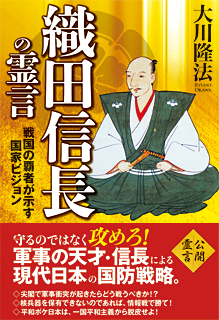
Happy Science (in Japanese: 幸福の科学 / koufuku no kagaku) is a Japanese “new religion”, that was founded by Ryuho Okawa in 1986 and has gone onto be one of the most successful of these eccentric cults. The theology itself seems to be a melange of traditional Buddhist cosmology with a wide assortment of generic new-age pablum, topped with a very strong layer of veneration of the “Master Okawa”. I don’t want to get into their highly entertaining cosmology in this post, except to say that reading a Happy Science-published book on the subject several years ago made me wonder if I was reading a Japanese translation of the Dungeons and Dragons Manual of the Planes.
To get a taste of their style, as well as the eclectic basket of influences they draw upon, here are a couple of brief excerpts from their official website:
El Cantare is the Lord, Buddha and Savior. He is the supreme God of the terrestrial spirit group who has the highest authority over the planet Earth and is directly connected to the Primordial Buddha or Primordial God – the Creator of the whole universe.
Lord El Cantare has also sent down parts of his own consciousness – brother souls – to guide humanity in the right direction at the most important times in history. El Cantare’s brother souls who have been born to Earth in the last twenty thousand years are:
La Mu – 17,000 years ago on the Mu continent
Thoth – 12,000 years ago in Atlantis
Rient Arl Croud – 7,000 years ago in the Incan Empire
Ophealis – 6,500 years ago in Greece
Hermes – 4,300 years ago in Greece, Crete Island
Gautama Siddhartha (Shakyamuni Buddha) – 2,500 years ago in India.
Needless to say, that last line about the cult’s leader being a reincarnation of the creator of the universe is the most significant teaching in the entire religion, and the core of the entire enterprise. Although they claim that “The grand mission of Happy Science is to create utopia – a world filled with love, peace, harmony and prosperity”, Okawa from the beginning combined his religious teachings with a hard-right political ideology. I found a 1991 AP story, that describes him as follows:
Lights go off. White smoke rises on stage. A round-faced, chubby man in a dark business suit appears in a spotlight before thousands of admirers. He claims he is Japan’s Messiah, the reincarnation of Buddha.
The man portrays the Japanese as a chosen people destined to destroy the United States and the Soviet Union and make China “a slave.”
[…] In his book “Nostradamus: Fearful Prophecies,” Okawa asserts that only the Japanese Leviathan will survive the imminent end of the world after destroying the United States and the Soviet Union:
“In the 21st Century, there will be no enemies for Leviathan. It will slash throats of the old eagle and the exhausted red bear, and laugh at the aging Europe. It will use China as a slave and Korea as a prostitute.”
The same article briefly describes his business model, which may sound familiar to readers who have read about Scientology.
Annual revenues are about $45 million, most of it from donations, according to Teikoku Data Bank, an independent research company.
Group spokesmen admit that up to 90% of their members do nothing more than subscribe to a monthly magazine, “Science of Happiness,” for $100 a year. But they say as many as 200,000 people have become “true members.” Critics put that number as low as 20,000.
To become a true member, one has to read 10 of Okawa’s books and pass exams on them.
The Happiness Realization Party is also not new, and was first discussed on this blog back in 2009, when Adam wrote a series of posts about the candidates running for a seat in the Diet’s lower house, representing his district in Tokyo. The party had only been founded that year, and the candidate Adam wrote about, Kazumasa Fujiyama, only won about 1% of the vote. In the May, 2010 election, the HRP won their first Diet seat when Yasuhiro Oe, who had been elected as a proportional member representing the Japan Renaissance Party, decided to change his affiliation to HRP post-election. As my co-blogger Adam explained back in 2010:
The Wakayama native [Yasuhiro Oe] first became an upper house member in 2001 as a PR candidate on the LDP ticket, then as a DPJ candidate in 2007. He later joined JRP as a founding member in 2008, citing problems with the DPJ’s methods. In terms of policy, he has adopted some typical right-wing positions – he’s pro-Taiwan, a firm Nanjing Massacre truther, and a vocal supporter of the victims of North Korea’s kidnapping program. He comes up for reelection in 2013.
A 2009 Campaign Poster for the Happiness Realization Party featuring Jikido Aeba, with the English language slogan “Start! Japanese Dream!” written phonetically in Japanese.
The platform of the Happiness Realization Party includes many elements of mainstream Japanese conservatism that overlap with the ruling (conservative) Liberal Democratic Party, as well as some elements that diverge sharply from any mainstream party. To quote from Adam’s 2009 post:
Among their chief policy proposals:
Revise the constitution to allow a pre-emptive strike on North Korea if necessary.
Eliminate inheritance taxes and consumption taxes.
In the cities, “bring work and home closer together” by building offices and residences in the same building.
Build an enormous monorail around the entire city of Tokyo.
Allow massive immigration and promote reproduction to increase Japan’s population to 300 million by 2050
Some of their most radical proposals can be found in their draft constitution:
Make a directly elected president the head of state. The president would have the right to issue presidential orders apart from parliamentary legislation. If an order and legislation contradict each other, the chief justice of the supreme court would decide which to follow. But if there is no decision in two weeks, the presidential order will take precedence.
The emperor “and other traditions” would be kept on but with their power limited by law.
The chief justice of the supreme court would be directly elected.
Payment for public bureaucrats would be based on performance (this would be in their constitution!)
“Equal opportunity” and total freedom within the law.
The state must always aim to have a small government with low taxes.
“The mass media must not abuse their power and must act responsibly to the people.”
So, back to Aeba.
He remained involved in Happy Science and the Happiness Realization Party, holding positions such as HPR Director of Public Relations (2011) and Director of Investigations (2013), until he resigned in 2015 to start the Japan Conservative Union. During the last few years of his tenure in the HRP he seems to have been laying the groundwork for this transition, not only with schmoozing such as the 2012 CPAC visit mentioned above, but publishing a small selection of books tactically chosen to bolster his credentials to conservatives in both Japan and America as a conduit to the other country.
It is vital here to make note of his co-founder in the JCU, Shun Eguchi, who spent his career in the Sankei Shimbun, Japan’s conservative, business focused newspaper that can be thought of as similar to the Wall Street Journal, and he ended his career as president of their more specifically business-focused publication, Fuji-Sankei Business Eye. Eguchi is also a graduate of Takushoku University, considered to be a hard-right institution, with ties to many figures known for conservative revisionist historical views.
In 2011 he published the book The Strongest Country – Japan’s Decision, and the from the book’s official description on Amazon it sounds like some pretty generic conservative pablum about strengthening national defense and the economy, mixed with criticism of welfare states such as Sweden.
He has also supervised a fairly weird looking pro-Trump book called Presidential Feng-shui, co-authored by a wacky Feng-shui huckster by the name of Dr. Copa ((His real name is Kobayashi Yoshiaki, and the book was co-written with his son, Kobayashi Teruhiro)). In this book, Dr. Copa explains how Trump (perhaps inadvertently, I’m only reading so much of this nonsense) used the power of feng-shui to win himself the White House, in particular via the magico-spatial relationship between the White House and the location of the Trump hotel in Washington’s Old Post Office Building. The magazine Weekly Shincho reported that Dr. Copa is such a big fan of Trump that he was a paying audience member at Trump’s inauguration, so that he could be closer to his “research subject”. And, unsurprisingly, it was Aeba – who was also in attendance at the inauguration and “Liberty Ball”, according to his persona blog, who served as the intermediary to obtain the tickets. In an interview with Shincho, Dr. Copa briefly explains his theory of how Trump used the architectural feng-shui power of the Old Post Office in an identical way to how the location of Toyotomi Hideyoshi‘s camp relative to Kiyosu Castle allowed him to achieve a surprise victory at the 1582 conference at that castle that contributed to his consolidation of power.
On a brief search I don’t see any direct connection between Dr. Copa and Happy Science, but it is hardly surprising that a (former?) member of a weird science-fiction inflected cult is also interested in pop-parapsychology.
The Shincho article on Dr. Copa mentioned as an aside that Aeba had described himself as an “Advisor” to the American Republican party, but that there was no evidence of this. Buzzfeed Japan has an article on this exact topic from November of last year. In this piece they list his repeated claims, both online and in media appearances in Japan, that he is an official advisor to the GOP. They describe how, in addition to doing online research, they had their colleagues at Buzzfeed America do some investigation. It turns out that nobody at the Republican National Committee (RNC) knows who Aeba is, but Buzzfeed Japan emails Aeba to ask for clarification.
As evidence of his claim, Aeba forwards them an English language email from Bob Sparks, the American political consultant who worked as a fixer during the 2012 CPAC visit reported by The Atlantic. According to Sparks, Aeba was an “unpaid advisor to Sharon Day“, who is currently the co-chair of the RNC, but Day did not respond to queries and no additional proof was offered. Their seemingly correct conclusion is that while Aeba may have been informally told by Day herself that he was her advisor on US-Japan relations, but that he never had any official position with the RNC or any affiliated organizations. However, he continues to proudly misrepresent himself
As I mentioned earlier, despite having a genuinely substantial political career with the Happiness Realization party, Aeba makes absolutely no mention of them or Happy Science on the Japan Conservative Union website, despite describing himself prominently as an advisor to the GOP. (Although his personal blog, which goes all the way back to 2009 when the HRP was founded and is still updated regarding his current activities, so at best he has made a half-hearted attempt to truly hide his past.)
In that same article, Buzzfeed noticed that he had likewise never made note of his former HRP affiliation on any of his recent media appearances, and none of his hosts organizations or publishers had identified him as such, and so they asked Asahi Broadcasting, Fuji Television, Futaba Publishing, and Sankei Shimbun for comment.
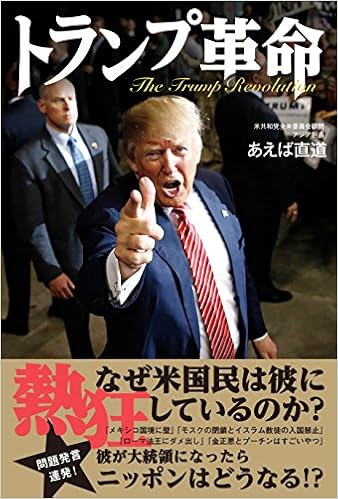
Only Futaba, the publisher of his 2016 book The Trump Revolution, replied, saying that they had avoided mention of his ties to Happy Science in consideration of his telling them that, his “relationship with the Happiness Realization Party is not good.” Does this mean that the HRP is angry at him for cutting ties with them and starting his own personal brand, or is he simply making an excuse?
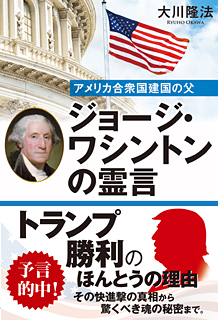
It is unclear to me whether Aeba retains any ties with Happy Science, but it is clear that his goals align with theirs. In October of last year, Ryuho Okawa published yet another of his spirit interview books, in which he “interviewed” the ghost of George Washington and the guardian spirit of Donald J. Trump, and explained that Trump is in fact the reincarnated spirit of America’s first president. “If candidate Trump becomes President, 300 years of future prosperity are promised for both Japan and America, but if it is Hillary, then America will lose its leadership role in the world.” The sequel, containing more interviews with Trump’s guardian spirit is already out, and new-age spiritual mumbo-jumbo aside, I suspect one would be hard pressed to tell the content apart from any of the speakers at CPAC.
Hopefully Aeba’s new speech will be up soon so I can see how it fits in with everything else, and I will find time in the near future for more writing on related topics.





 El Cantare is the Lord, Buddha and Savior. He is the supreme God of the terrestrial spirit group who has the highest authority over the planet Earth and is directly connected to the Primordial Buddha or Primordial God – the Creator of the whole universe.
 La Mu – 17,000 years ago on the Mu continent
 according to Teikoku Data Bank, an independent research company.
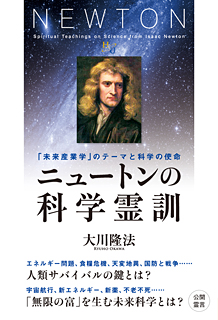 You may have noticed mention above of a book entitled “Nostradamus: Fearful Prophecies,” which is strongly representative of Okawa’s prodigious output. Of the
 magazine Weekly Shincho reported that Dr. Copa is such a big fan of Trump that